
Pons facts for kids
| Brain: Pons | ||
|---|---|---|
Quick facts for kids
 |
||
| The pons, located in the brainstem | ||
 |
||
| A view of the medulla oblongata and pons from the front and below | ||
| Part of | Brain stem | |
| Artery | Pontine arteries | |
| Vein | Transverse and lateral pontine veins | |
The pons (which means "bridge" in Latin) is a vital part of your brainstem. Think of it as a control center and a busy highway for messages. It's found in the brains of humans and other mammals.
This important part of your brain sits below the midbrain and above the medulla oblongata. It is also in front of the cerebellum. The pons helps connect different parts of your brain. It sends signals from the main part of your brain down to the cerebellum and medulla. It also carries sensory signals, like touch and sound, up to the thalamus.
Sometimes, the pons is called the pons Varolii. This name honors Costanzo Varolio, an Italian anatomist and surgeon from the 1500s.
Contents
What the Pons Looks Like
The pons in humans is about 2.5 centimetres (0.98 in) long. That's about the size of your thumb! It's located right in the middle of your brainstem. It sits between the midbrain above it and the medulla oblongata below it.
Imagine looking at the front of your brainstem. You'd see a small groove that marks where the pons ends and the medulla begins. From this area, important cranial nerves (nerves 6, 7, and 8) emerge. These nerves help control things like eye movement and facial expressions.
If you were to look at a slice of the pons, you'd see it has two main parts. There's a front part, called the basilar part, and a back part, called the pontine tegmentum. The front part often has a small groove where a major blood vessel, the basilar artery, might run.
How the Pons Gets Blood
Like all parts of your body, the pons needs blood to work. Most of its blood comes from small blood vessels called pontine arteries. These arteries branch off from a larger artery known as the basilar artery. Other parts of the pons get blood from the anterior and posterior inferior cerebellar arteries.
How the Pons Develops
The pons starts to form very early, when a baby is still developing inside its mother. It grows from a part of the early brain that also forms the cerebellum. This shows how closely these two brain parts work together.
Important Nerve Centers
The pons contains special groups of nerve cells, called nuclei. These nuclei are like small control centers for several important cranial nerves. These nerves are numbered 5 through 8:
- Cranial Nerve 5 (Trigeminal Nerve): This nerve helps you feel sensations in your face, like touch and temperature. It also helps you chew your food.
- Cranial Nerve 6 (Abducens Nerve): This nerve helps control the movement of your eyes.
- Cranial Nerve 7 (Facial Nerve): This nerve is in charge of your facial expressions, like smiling or frowning. It also helps with taste and making tears and saliva.
- Cranial Nerve 8 (Vestibulocochlear Nerve): This nerve is crucial for your hearing and your sense of balance.

What the Pons Does
The pons is a very busy part of your brain! It acts like a relay station, sending important signals between the main part of your brain and the cerebellum. The cerebellum helps with coordination and balance.
The pons also has many other key jobs:
- Breathing: It helps control your breathing, making sure you inhale and exhale smoothly.
- Sleep: It plays a role in regulating your sleep cycles. It's even involved in why you might experience sleep paralysis sometimes. The pons also helps create your dreams.
- Senses: It processes information related to hearing, balance, and taste.
- Movement: It helps control eye movements, facial expressions, chewing, and swallowing.
- Posture: It helps maintain your body's posture and balance.
- Bladder Control: It assists with bladder control.
When the Pons Needs Help
Sometimes, the pons can be affected by certain health conditions. One example is a rare condition called central pontine myelinolysis. This condition can make it hard for a person to keep their balance, walk, feel touch, swallow, or speak clearly.
It's important for doctors to identify and treat such conditions. If not treated, it can lead to very serious problems, including a state where a person is awake but cannot move or speak.
The Pons in Other Animals
The pons is not just found in humans! Many other animals, including other mammals, have a pons. Scientists believe the pons first developed a very long time ago. Even ancient fish-like creatures called lampreys have a form of the pons. This suggests that this important brain part has been around for at least 525 million years!
More Images
-
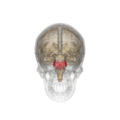
An animation showing the location of the pons.
-
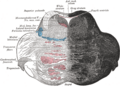
A cross-section of the upper part of the pons.
-
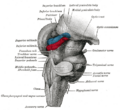
A view of the back and side of the hindbrain and midbrain.
-
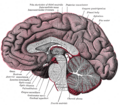
A view of the brain cut down the middle.
-
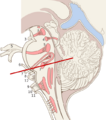
The nerve centers (nuclei) within the pons and brainstem.


See also
 In Spanish: Puente troncoencefálico para niños
